Friday, 8 January 2016

Yosemite 3

I've realised that Yosemite is somewhere I intend on coming back to again and again. I love it! The climbing is challenging and engaging in a way that I haven't found anywhere else. To climb hard there it's not enough just to be strong, skilled, bold or tough, you have to have a bit of everything. Basically you have to be a good climber. I read an interview with Tommy Caldwell where he said it took him 4 years just to learn how to use his feet on El Cap granite, and this is what ultimately made the difference between 5.13 and 5.14 for him. I find this hugely inspiring and motivating, I've only had three trips, imagine if I learned to use my feet properly! With this in mind my goals for my third Yosemite trip were more about learning and improving than any one specific objective. This felt very different to my first two trips, both of which had been focused on the one goal of free climbing El Capitan via Freerider. It was great to arrive back in the Valley with no expectations, I felt relaxed and able to enjoy my favourite place in the world!
Crimping hard on Freerider last June.
We spent the first 3 weeks in Tuolumne; the high country above Yosemite Valley. Peace is a famously thin 5.13+ (8a+/b) slab and wall climb on the beautiful golden West face of Medicott dome. I had seen this sweet poster of Ron Kauk making the first ascent when I was a kid.


Peace is an enormous 60 meter pitch climbing a black streak on a golden wall, it varies between 85 and 95 degrees; a testpiece of techy wall climbing. The wall is covered in Tuolumne's infamous granite chickenheads or "knobs", with virtually no distinguishing features at any point. The crux seemed to be just remembering which part of the route I was on! At any one time I could reach maybe 20 knobs and 19 of them were so bad I'd fall immediately. I loved the style of climbing, and it was especially fun since my friends Alan Carne and Brette Harrington were working on the Bachar Yerian a few meters to my left. We would have leisurely chats, suspended above the floor between attempts. I had quite a strange progression on the route, it took 3 sessions just to do all the moves in isolation, and I sent the route on my first proper redpoint, completely out of the blue, on my 5th day. Such a beautiful line!


The first crux
Peace goes into the sun just after midday, making the climb about 100 times harder. In the afternoons Bron and I were loving life, charging up granite dome after granite dome. We climbed the moderate routes, and practiced moving fast. We would take one short half rope and simul-climb large sections, often putting a micro-traxion or a rope-man between us to protect the leader if the second were to fall. Climbing this way is outrageously fun, it's difficult to describe the feeling apart from by saying it makes regular pitched climbing feel like a snails-crawl.  One great day we managed to climb 3 routes on Fairview dome in an afternoon!

Sunset after our 3rd route on Tuolumne's Fairview Dome!
As the weather got colder we moved down into the Valley proper and continued running up thousands and thousands of feet of granite.

Highlights:

Royal Arches North Dome. We climbed what is normally 24 pitches of climbing in 4 long "simul-blocks" reaching the summit of North Dome before midday!

5000 feet of climbing and it's only midday!
The Rostrum, I was delighted for both Bron and I to get the onsight of this iconic crack climbing testpiece.

Bron cruising the Rostrum
Astroman. It only took me three trips across the Atlantic and three separate attempts to finally send this climb. Specifically the Harding slot, a pitch that is supposedly 6c! I just needed Bron to get the top rope up there for me first! The next challenge is going to be doing the Rostrum AND Astroman in a day, my hands hurt just thinking about it!

Bron getting my top-rope up for me on the Harding slot.
Mount Watkins

Much of the Valley was extremely crowded in October, I heard tales of 10 or more teams on the first half of Salathe/Freerider! I was keen for a Yosemite free climbing adventure that was a little bit more off the beaten track. The South face of Mount Watkins ticked these boxes and the crux was rumoured to be a 5.13c/8a+ dyno, I was sold! We packed for 4 days, one to hike in, two days climbing and a fourth to hike off the top. Getting to the base of the wall turned out to be quite a logistical challenge, we hiked for about 4 hours up the secluded Tenaya Canyon, taking us far from the tour buses and burger stands of the Valley proper. We filtered water from Tenaya Creek and began the epic task of getting our haulbag to the top of the "4th class" at the base of the wall. Some of the "4th class" turned out to involve soaking wet slabs up to 5.8!

Endless low angle slabs, the wall just kept getting further away!
I had just enough light left on our first day to have one attempt at the first hard pitch, a low angle blank looking 12a slab. A beautiful pitch that made all the slog of getting to the wall seem instantly worth it.
onsighting the first pitch, 12a slab!

We woke before dawn and climbed all the next day, there was not another person in sight; we had the whole of Tenaya Canyon to ourselves! At dusk we reached to an amazing bivy ledge above pitch 11, and set up camp.
Bron jugging our fixed line at dawn.
Beautiful view of Half Dome.
Bron leading the outrageously exposed pitch 10, possibly the best pitch of 5.3 in the world!
Our alarm went off at 5am the next morning, I knew that all the hardest climbing still lay above me. I felt excited to try my hardest and give it my absolute best shot!

Sunrise of day 2 on the wall.
The first crux was the "pendulum bypass pitch", a very thin 12d/7c layback with small gear, finishing with a few long slaps between crimps on the face. I was surprised and delighted to onsight it, it felt pretty touch and go on some of the sketchy, smeary footholds!
Shaking out and eyeballing the crux of the "Pendulum Bypass pitch".
The next obstacle came immediately afterwards in the form of the 13c "dyno pitch", I was looking forward to trying this one! I went up and fell many times trying the dyno, before eventually figuring out a way of doing it static! I quickly realised I wasn't going to stand a chance until it came into the shade. We waited on the ledge, huddling in the shade cast by our haulbag as the sun moved across the sky. At last light I fought my way upwards, clawing my way past the boulder crux before almost losing it on the thin slab above. I arrived at the anchors as the sun set, exhausted and shaking, in semi-disbelief that I'd actually pulled it off.

The "dyno pitch"!
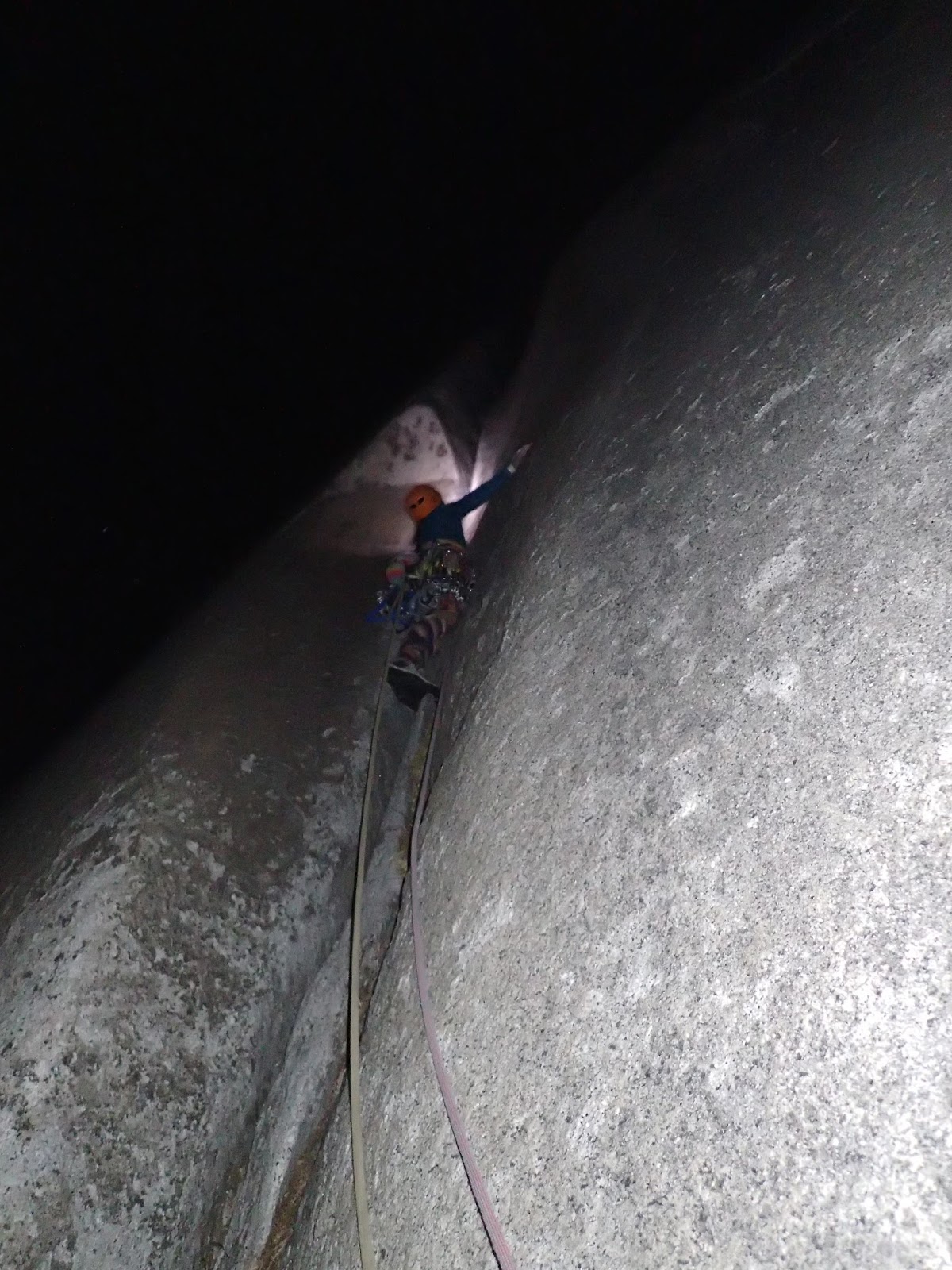
The downside to waiting all day to get the pitch in the shade was that we now had to climb to the top in the dark! Bron took the lead and took us up some gnarly 10d flare pitches by headtorch. It felt spooky climbing in a little ball of light, but knowing there was 2000 feet of empty space beneath my feet that I couldn't see. It was all I could do to second the pitches clean in my exhausted state.

Bron leading off into the night.
We reached the top of the wall at 1:30am, I was really pleased to have free climbed the whole route, but more importantly to have had an epic adventure with my girlfriend on a sweet big wall!

On the summit, exhausted but happy.
Saladay

On one of our last days in the Valley I got the chance to climb with Shayna Brown, a Valley local who's been climbing a bunch of big walls at blazing speeds. It was a great opportunity to practice and learn more about speed climbing techniques. We decided to climb the Salathe wall on El Capitan in a day (Saladay!), which is slightly harder than the Nose-in-a-day due to being a bit longer and having a lot more mandatory wide crack climbing.

It was another outrageously fun day, we "short-fixed" the entire wall using a "Pakistani Death Loop". The second would jumar at running pace with music blaring from the mini-speaker clipped to their harness. Speed climbing big walls is completely different to free climbing them, I enjoyed the different mindset where anything goes as long as you keep moving upwards and bolts become jugs. I can't wait to do more of this type of thing in the future! We climbed the wall in a little over 17 hours, it got dark just as we got onto the infamous headwall. Swinging about up there in the dark was atmospheric for sure.

Looking down the "enduro corner", good exposure!

Shayna's feet getting onto the headwall.

Bron and our friend Tito met us on top with a stove, sitting at the top of El Cap at midnight after climbing the whole of the Salathe and being made hot chocolate was one of the more special moments of my climbing life.

Wednesday, 19 August 2015

Norwegian big walling

I just got back from 3 weeks in Arctic Norway climbing on the 400m North face of Blamann with Dave Macleod and later Calum Muskett. The aim was to have a go at free climbing one of the aid routes up the central steepest part of the face. Disko 2000 takes a direct line through a series of huge roofs. I saw the trip as an amazing opportunity to learn some new things from a pair of very experienced climbers, I left with no expectations.

The wall, from base camp
Arriving into Tromso airport to midnight sun and meeting Dave was an odd experience. I felt somewhat self conscious setting off on a big climbing trip with someone whose climbing had inspired me for many years, but who I'd never actually met in person. Luckily I was able to prove useful straight away, by hiking huge loads of ropes and gear up to the base of the wall. Dave was recovering from ankle surgery so had to take it easy with the carrying. I felt relieved that even if I wasn't going to be able to climb anything, I'd already done something towards making the trip a success! 


Dave kicking steps to the base of the wall
It looked as though the wildly overhanging first half (roughly 200m) would be the crux for free climbing, after this the face slabbed out a bit. Our plan was to aid the steep part and get fixed ropes in place which would allow us to work the pitches. The aid turned out to be pretty scary! A particularly bad moment was when Dave was aiding his way up an expanding flake 5m directly above me. Each peg he hammered in the flake detached further from the wall. I could hear it creaking. I cowered behind a small roof, trying to get as much of my body out of the firing line as possible in case Dave, the flake or both were to detach from the wall. That day we climbed until 6am, the north facing aspect meaning we were climbing in the sun in the middle of the night. Around midnight there was this spectacular, seemingly never-ending sunrise/sunset.


Once we had the first four pitches fixed, Dave decided to spend a day working some moves on the lower pitches whilst I offered to go aid soloing above to get our fixed ropes higher. I've always been fascinated with the idea of rope soloing. The whole face was enveloped in cloud that day, it felt wild to be up high on the wall, in my own little bubble of visibility inside the swirling clouds. Aiding pitch 7 I was required to do a pendulum 4m to my right to switch crack systems. I puzzled about how we would free climb this part. I spotted a jug miles out to my right, "I wonder if it would be possible to just jump to that?" I thought... 

rope solo fun-times

Disko 2000 shares the first two pitches with an existing free route called Arctandria. Pitch two gets 8a+, the crux of Arctandria. 40m of perfect clean corner with a thin crack in the back. The crack is so thin in sections that it has to be aid climbed using very thin beaks. We left a few of these in as protection when free climbing, I didn't like the idea of testing them. My first work session on this pitch was dispiriting. There was body-length of climbing that I just couldn't figure out. It seemed to either require crimping on impossibly small edges or standing on impossibly blank smears. I went down to camp disheartened. It then rained for four days straight, sat in the tent for hours upon hours I did not rate my chances of climbing that corner!


When the rain finally stopped I went back up for another play. I found a way of doing the move, which involved a crazy "crucifix" style palm out behind me, followed by a desperate "windmill" move to snatch a fingerlock. It was on. The next day we waited anxiously for conditions, heading up to climb late in the evening. It felt dreamlike as I climbed smoothly up to the precarious rest stood on a sloping shelf below the crux. I expected to fall. I felt my left hand opening on the crimp in the crack. I thought I was off right up until the moment I found myself holding the fingerlock at the end of the crux. For sure one of my best climbing performances to date. Brilliant. Dave climbed the pitch in the Polar twilight shortly after me. We were getting it done!

The crux of pitch 2


The next day we tried the other 4 of the first 5 pitches. Dave pulled out a smooth send of pitch 4, another amazing 8a+ pitch. This one climbing in and around multiple roofs on crimps. It was particularly impressive since it happened to be pouring with rain at the time. I was getting soaked at the belay, but the pitch was staying dry! I wasn't able to do one of the moves on this pitch. I would have loved to be able to climb it, in fact, it may have inspired me to do some fingerboarding!

Dave on pitch 4


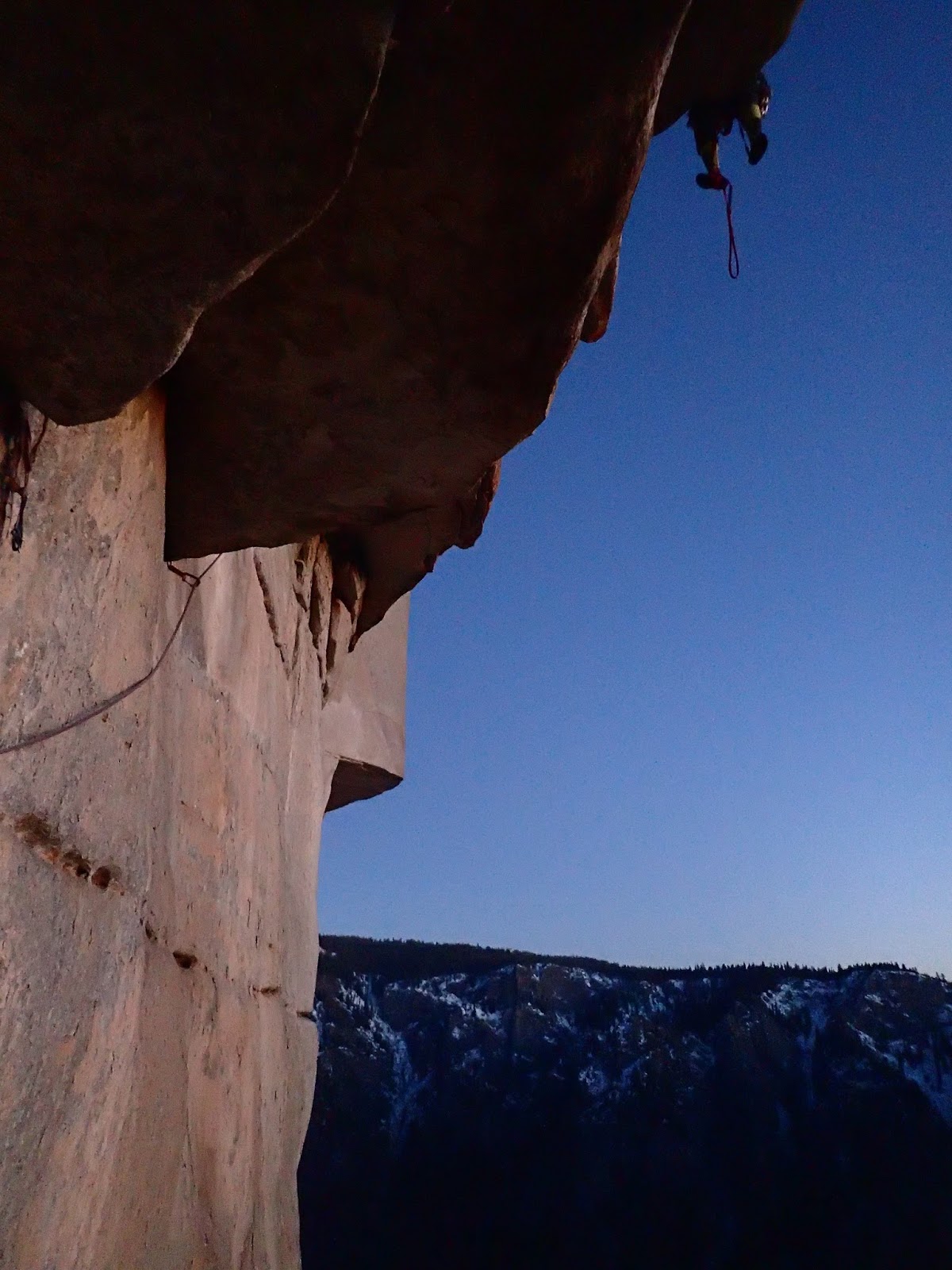
The other highlight of the day was pitch 5, the "Kalk & Gummi" roof as it was dubbed by the first aid ascentionists. It's for sure one of the most eye-catching pitches on the route. A 45 degree overhanging finger crack, with some wild crux moves to catch a jug on the lip. The problem was that the crack seemed to be permanently soaked in a thick black slime. Amazingly it became apparent that the finger-locks were so bomber you could use them even in the wet. We took it in turns having goes at leading the pitch, making a paste of chalk and slime, which turned out to be slightly more sticky that just slime! Water was running down my arms as I pulled between locks. Catching the jug on the lip and cutting loose has to be one of the most heroic positions I've ever found myself in! If I was to design a free climb I couldn't ask for a more perfectly positioned hold.

Dave on the lip of the Kalk & Gummi roof
The next day we jugged up to the top of the Kalk & Gummi roof with the aim of free climbing to the top from there. We soon found ourselves underneath pitch 7, the dyno pitch. Dave went up on our fixed rope and much to my disappointment, found a way of free climbing around the dyno move, going right a few meters higher. It looked desperate. He offered to lead the pitch his way, but I had a nagging feeling that I'd regret it if I didn't at least have a go at the dyno. I asked if it would be ok for me to have a bash first. Both feet pasted on smears and eyeing up the jug way off to my right, it suddenly looked a lot further away and less jug-like. Detaching brain, I flung myself sideways across the void, touched the hold and skittered off downwards to meet Dave at the belay 8m below. I think both Calum and Dave thought I was completely mad when I mentioned I was going to have another go. The second failed attempt left me with blood pouring out of my right hand and visibly shaking from adrenalin. I was getting closer! Dave suggested moving in more of an arc motion rather than a straight line. I thought of what Johnny Dawes might say, "you've got to find the fast currents". I visualised my path through the air like one of those Donnie Darko movement trains.  Actually maybe I didn’t do any of these things, anyway, I stuck it! Just. Feet pedaling wildly I stood up on the shelf I'd jumped to. I had to stand there for about ten minutes to stop shaking enough to lead the rest of the pitch. 

Disco 2000, 8a+ Blåmman from Dave MacLeod on Vimeo.


Dyno!


Incredible climbing after the dyno on pitch 7
This pitch was the end of our fixed ropes. We were just over half way up the wall. The weather was starting to look pretty terrible. It seemed to be raining on both sides of us. Calum decided to head down, leaving me and Dave to press on towards the top. Both of us fully expecting to bail when it started raining in ten minutes time. But it didn't. Somehow the storm was holding off. The route now followed a large corner system which turned out to be pretty wet, Dave pulled out an amazing lead of a pitch that would be solid E5 if it were dry. There followed a somewhat gruesome squeeze chimney that turned out to be my lead. As we climbed higher the weather looked worse and worse. I started to get pretty scared at the prospect of navigating our way back down the wall in the storm should we have to bail. I was seconding the last pitch to the top of the wall as the heavens opened and we were both soaked to the skin. Amazing timing!

Summit! In the pouring rain
I was disappointing not to be able to redpoint pitch 4, but happy with how I climbed on the rest of the route. We did it in the best style we could, given some atrocious weather; redpointing the first 5 pitches over two days (I managed 4 of these), then climbing the rest of the route to the top on day 3. The one day free ascent is still there for the taking and would be a very good effort indeed!

Topo of Disko 2000 free route

Friday, 10 July 2015

The Nose-in-a-Day with Danger Darren

I wrote this after climbing the Nose on El Cap twice in a week in spring 2014. Enjoy!

I’m lying on the grass in the Californian sun; even with my eyes closed I can feel the expanse of El Capitan towering above me. I got down from the Nose with Bron, my girlfriend late last night. We climbed the most famous big wall route in the world over 4 days, sleeping on the few conveniently spaced ledges on the way. Now it’s time for victory photographs and relaxing in the sun…

I slowly open my eyes and look up to see the manically grinning face of my friend Danger Darren from Tasmania. He seems to be saying something, he wants to climb the Nose with me, but I just got down from the Nose… What’s going on?


My alarm goes off at 3am the next morning, I stumble out of the tent, my pockets stuffed full of disgusting energy gels and Clif bars. In order for Darren and I to climb all 31 pitches of the Nose in a day, we will be block leading in a “French-free” style, short-fixing with a "Pakistani death-loop" and simul-climbing where possible. All highly un-recommended ways of climbing faster in exchange for some of the safety of regular pitched climbing

Leading the first pitch before dawn I’m rushing. Both feet pop and I’m off, somehow by reflex I catch my fall in a one-arm lock off on a cam.

“Take it easy, you’re not Hans Florine.”

After the first pitch things begin to feel easier, the sun is coming up and I start to enjoy myself. I find my bivi bag that I dropped from high on the route 3 days earlier. It fell 22 pitches to land back on the Nose! The day is off to a good start.
  
Next we get overtaken by Hans Florine himself, the king of the Nose speed record! Climbing the route for his 97th time, just as a quick hit before heading to a party in San Francisco, as you do.


Climbing quickly and efficiently over the endless golden granite in the sun feels over-the-top euphoric. About halfway now.

  
My block takes us to the Great Roof, which I swing across making good use of the plentiful “fixed mank”, but clipping no runners. This way Darren can second the pitch quickly whilst I’m self-belaying up the Pancake Flake.

“Hey Darren… this is fun!”

I casually stand up in a wire and PING…

Crunch.

I stand up on the ledge and spit. Blood.

“Where am I bleeding from?”

“Darren, where am I bleeding from?!”

“err… dunno mate turn around… Nah, looks like you’re good”

“My foot hurts. MY FOOT HURTS! I think I’m ok apart from my foot… but I think my heel is broken.”

A quick “up or down?” discussion leads to the full realisation that we are 22 pitches up a 31 pitch route with only one 60m rope; the idea of retreat is not a pleasant one. I think I can probably still jumar and Darren says he can take us to the top. At this point it would be easy to be feeling pretty sorry for myself, but to my surprise I find I am actually enjoying the experience. The situation is a bad one, but not life threatening, and getting off the route is going to be a real adventure.

A few pitches higher I’m lying on the ledge below the infamous Changing Corners pitch, Darren seems to be grinding to a halt. I’m there for 2 hours, my foot throbbing, my body aches now the adrenalin is cooling off. Two falls, but he finally makes it to the belay. I pinch some ibuprofen off some Swiss climbers who arrive to spend the night on the ledge, unclip, swing, and begin ascending the free-hanging rope. The 800m of exposure below my feet feels wild.

Darren tells me his arms are toast and there’s no way he can lead the final four pitches.

“Are we having an epic?”

“Dunno, I hope not!”

With one approach shoe and one rock shoe I set off, trudging upwards, terrified of falling and jarring my foot again. I’m not really thinking any more, not scared or excited, just mechanically going through the motions necessary to get us off the route.

I stagger over the top just as the sun sets completely, almost exactly sixteen hours after starting climbing. I flick on my head-torch and sit down. My mind is alive with excitement and emotion again. Despite my injured foot, I’m aware right now that this is why I go climbing, for this kind of intense experience that’s impossible to find in regular mundane existence. Darren whoops as he tops out.


Tuesday, 30 June 2015

Freerider


Freerider from Jacob Cook on Vimeo.

My ankle skidded down the coarse granite inside the crack, I could feel chunks of skin being sheared off like in a cheese-grater. All the muscles in my body were going into melt-down, I was exerting near-maximum effort just to stay in the same place. I gave one final huge push to go upwards and made a kind of pathetic power-whimper. It was hopeless, I slumped onto the rope. Looking down I could see my girlfriend Bron stood on the ground ten feet below me, this was my second try at Generator crack.

Generator crack in Yosemite is graded 5.10c (or 6a+), it's about 40 feet high and an offwidth. It took me 2 sessions to successfully tredpoint… Yes, that’s like redpoint only on a top rope. I would flail and scream for ten minutes before slumping onto the rope in exhaustion and despair. Bron wasn’t helping by repeatedly slithering up the thing like it was a tourist trail. Climbing with flawless technique, she would wedge her left foot deep inside the crack then shuffle upwards an inch at a time by heel-toeing her outside foot and making a motion “like pumping up an air bed” she said. I decided it was because I was too tall, next it was because I had weak ankles, skinny thighs, big feet… the excuses were plentiful.

Someone that isn't me on Generator Crack,
giving a perfect demonstration of a "chickenwing"...

When the successful tredpoint finally came I hadn’t done anything different except trying REALLY HARD, so hard in fact, that I discovered a new kind of power scream, which Bron kindly named my “dying hyena noise”.

It’s a popular climb and whilst I was working it there would regularly be a crowd at the base. People would look at me like I was mad when, after watching my atrocious performance, I would tell them I was hoping to try Freerider on El Capitan.

Freerider had been an obsession of mine for two years; it was the main goal for my three month USA trip. It’s the easiest of the free routes on El Cap, but with 5.13a (7c+) crimping and a lot of burly wide crack climbing, it’s no pushover. The names of the pitches had permeated my dreams: “the Huber pitch”, “the Enduro Corners”, “The Hollow Flake”. It was slipping away. The reason; pitch 19 “The Monster”.

“It’s an extremely intimidating pitch”

was my friend Dan Mcmanus’s helpful comment to me before I left. It really is! Almost 60m of continuous offwidth crack, with not a face hold or crimp in sight. It was inconceivable given my abysmal performance on Generator crack, a supposedly easy offwidth, that I would stand a chance on the Monster.

Climbing is what motivates my life, I generally consider myself a good climber and when I perform well I feel happy. For this reason I often end up equating my self-worth with my current performance. It’s a difficult trap to avoid. After repeatedly (and publicly) failing at Generator crack, I was extremely unhappy. I decided to give up on Freerider, why should I try something that I stood no chance of doing. I’d try another big wall free climb with less offwidths.

A few days of grumpiness later I had a realisation. Surely the main attraction with trying hard routes in the first place is because they are hard! If I failed on Freerider then so be it, I could always try again. I also realised that success wasn’t the point, regardless of whether I freed the whole thing I was virtually guaranteed to have a wild, memorable experience trying.

A month later I stood racking up at the bottom of El Cap with Bron and my friend Chris Bevins. I had no idea if I was good enough to climb the route, but that wasn’t important, I was excited to give it a go and especially excited to be trying it with two good friends. More importantly, Chris had offered to lead the Monster! For Chris, this was unfinished business after he’d free climbed all but about 100 feet two years before. Bron decided she’d have the most fun if she free climbed as much of the route as she could, but didn’t get too hung up about the whole thing. Our haulbags - packed for up to seven days on the wall, including two portalegdes and an inflatable shark – were already stashed ten pitches up at Heart Ledges. 

We climbed smoothly up the first 14 pitches. That night I slept soundly apart from fears that a resident mouse on our ledge would run across my face in the night. They live inside the cracks and somehow make their way to all the popular bivy ledges!


I woke up the next morning with butterflies, this was it, the day of the Monster. My body ached, I allowed some doubts to form in my mind, I felt like I needed a rest day already and all the crux pitches were still above us.

Chris leading the monster
Chris cruised the Monster, chatting casually to us as he shuffled the number 6 cam, one of three pieces of gear on the entire pitch. Bron absolutely hiked it too, they both made the “foot pump” technique look effortless. I felt frustration growing inside me, “how can it be so easy for these guys!?”. 

Bron in the Monster - "It's easy, just go like this..."
Something I’ve practiced over the years is shutting off any internal dialogue and just climbing. This is what I knew I had to do now. It wasn’t pretty. I started off finding the going hard and it got harder and harder. Multiple times both of my feet cut and my legs dangled, my body held in place by a measly chicken-wing. By the top I was a complete state, bellowing “dying hyena noises” across the valley and on the verge of tears from exhaustion. Chris was alternating between encouraging me and laughing hysterically at my efforts. I reached the belay, too exhausted to be happy, but that didn’t matter, I’d done it. 

In the Monster, before the savage burn kicked in.
That night we watched the sunset from our bivy in the Alcove. 20 pitches up El Capitan with two great friends and everything still to play for for the free ascent; I felt comfortable in the knowledge that I wouldn’t rather be anywhere else in the world. We brought the Hitch-Hikers Guide to the Galaxy and took turns reading a chapter aloud. I enjoyed doing the voice of Marvin, the depressed robot. 

 
The next day we opted to tactically rest in the shade of the Alcove for most of the day and go up and try the “Huber pitch” in the evening. Inspired by our friend Oli’s video we screamed “THE GREEEEEN DRAGON” at the tourist buses in the valley half a mile below. 


The Huber pitch is graded 5.13a or 7c+, a crazy dynamic boulder sequence, smack in the center of the 1000m face, amazing! A tiny, razor crimp and a rockover on a smear allow you to reach “the sugar-loaf”, a kind of scrittly sloper-sidepull. The problem is there aren’t any footholds in the right place to be comfortable on it. From here you have to make the “ninja-kick” move to a smear on the opposite wall of a dihedral. 

Photo by Jacob Bodkin
Sometimes on climbs that are right at my limit, I get this feeling that I’m watching myself climb from outside my body. What I love about big wall free-climbing is how good it is at inducing this state of focus. In the cool evening air my fingertips bit into the crimp, I could hear my fingernails scrape against the wall behind. The empty air beneath my feet faded into the background, I focused on my breathing and let my body climb, it knew how to do this. I came to from the trance to the sound of Bron and Chris whooping from the belay below me, I’d done it! Chris put in a sterling performance getting the pitch third go, his third ever 7c+, incredible.

We were well into the swing of things now, our team a well-oiled big wall machine. Over the next two days we forged on towards the top, tricky pitches like “The Sewer” and “The Enduro Corners” falling by the wayside. Since Chris lead the Monster it was nice to pull my weight with the leading on some of the harder pitches up high. Chris was getting tired though. On the evening of day four he had three unsuccessful goes at seconding pitch 27, a tricky 5.12b tips layback. The next morning I could tell he was nervous, his free ascent hung in the balance. I think it’s awesome watching someone try their absolute hardest on a climb, whether it’s a 6a or a 9a. Chris clearly gave it everything and when he got the pitch on his third try of the morning team psyche was at an all time high. For some reason there’s a tradition to make monkey noises whilst climbing El Cap, we beat our chests and howled gorilla noises from the hanging belay.

  
Our fifth night on the wall was spent at the Round Table. Both portaledges hanging out above the void, it was a spectacular bivy! We’d come around the corner now and could see the whole west side of El Cap. The more I look at the cliff the more intricate features appear, the colours on the wall to our left as the sun was setting were mesmerising. 


The final sting in the tail came the following morning in the form of the Scotty-Burke offwidth. It’s a flared offwidth in a corner with a kind of awkward bulge you have to get around. Chris, our designated offwidth ropegun, was having problems. He fell four times at the bulge, exhausted from 6 days on the wall and a lot of goes on some pitches below us. He slumped onto the rope after the fourth attempt looking utterly defeated. I couldn’t quite believe that our all-free ascent would fall at the final hurdle. I offered to have a go at leading it. I was able to layback around the section that Chris was having difficulty with. It felt totally wild to be laybacking the sloping side of the offwidth, my feet smeared on the glassy wall opposite, miles above my last runner and right at the top of El Cap. My arms were getting extremely tired though; this technique clearly wasn’t going to work for the whole pitch. I threw my left leg inside and turned my body into the crack. I was close to panicking as I fumbled to get the camalot 5 off my harness, preparing myself for the sickening feeling of sliding out. I slammed the cam deep into the back of the crack and tried to relax, this proved difficult. Somehow I fought my way to the top of the offwidth. Something clicked and I realised that the trick for me with offwidths is to just relax everything, apparently I don’t slide out.

We topped out at sunset on our sixth day, Chris and I having freed the whole thing. Less than a month before I had completely given up on my chances of climbing Freerider this trip. It reminded me that so much of success is down to mental attitude, I’m so happy I was able to turn mine around!

Video still - It looks like I was pretty happy when we topped out!
Bron in the Monster
The Alcove
Chris jugging our fixed lines to the Huber Pitch
Bivy at the Block
The 12a/b traverse
Bron and the bags in the spotlight. Photo: Tom Evans
Freight
"I'm pretty sure it goes that way..." photo: Tom Evans
Bron following a "5.7" chimney. Photo: Tom Evans
Glory!